Reading aloud gives words, closeness and a quiet moment in a day that is otherwise full. Most people know that. The hard part is making it happen when dinner was late, someone refuses to brush their teeth and you are nearly asleep yourself by page two. Here is what the research says, what reading together can look like at different ages and how it can find a place in the day that lasts.
Words nobody says at the dinner table
Books use a different language from everyday life. In the hall we say ‘put your shoes on’ and at the table ‘do you want some more milk?’. In a story someone creeps through a misty forest, a dragon sighs heavily and a door creaks on its hinges. When you read aloud, the child meets words that are rarely heard otherwise, in a setting that makes them understandable.
How much this adds up to was worked out in 2019 by Jessica Logan and her colleagues at Ohio State University. A child who has five picture books read to them every day has, by the age of five, heard about 1.4 million more words than a child who is never read to. Five books a day is a lot, but even one a day comes to many thousands of words a year.
And then there is what can’t be counted. A book makes it possible to talk about things that are hard to raise directly, such as fear, jealousy or being the new one, because it is the character in the book who feels it and not the child. And it is a time when an adult sits still, close by, and isn’t looking at a phone. For many children, that is the part they remember.
0–2 years: the voice, the rhymes and the pointing
The very youngest listen more to your voice than to the plot. Rhymes, repetition and sounds like ‘woof’ and ‘brrm’ catch their attention, and the same book can be read twenty times. Board books will survive being chewed.
It doesn’t matter if you never read the text all the way through. Point at the pictures, say what you see and wait for the child’s sounds. The moment can end when the child crawls off. Nursery rhymes and songs count too; they are reading aloud without a book, and they come along to the changing table. There is more about stories for the youngest under 0–2 years.
3–5 years: the questions arrive
Why does he do that? What would have happened if she hadn’t opened the door? Let the questions come, even if it takes a quarter of an hour to get through five pages. A conversation about a book is as much reading as the text itself.
This is also the age when the same book has to be read every night for three weeks, and when you get corrected if you skip a word because it’s late. It is tiring. It is also a sign that the story has become the child’s own. Read more about books for 3–5 years.
6–9 years: a book in several parts
Now you can read a longer book over several evenings, one chapter at a time. Stopping right in the middle of the exciting part and carrying on tomorrow is one of the best ways of getting a child to bed on time.
Children who have started school often read simpler books on their own and find them a bit dull. Reading aloud can offer stories that are still too hard to read alone but not too hard to understand, and keep the enjoyment going while their own reading is still slow. Stories for 6–9 years have more dialogue and a challenge to overcome.
10 and older: keep going anyway
Many people stop reading aloud once the child can read alone, but there is no reason to stop as long as you both enjoy it. Take turns: you read one chapter, the child reads the next. Or read the same book separately and talk about it over dinner, like a book club for two. Audiobooks in the car count too. Books for 10 and older have longer passages and more suspense.
How to make it happen
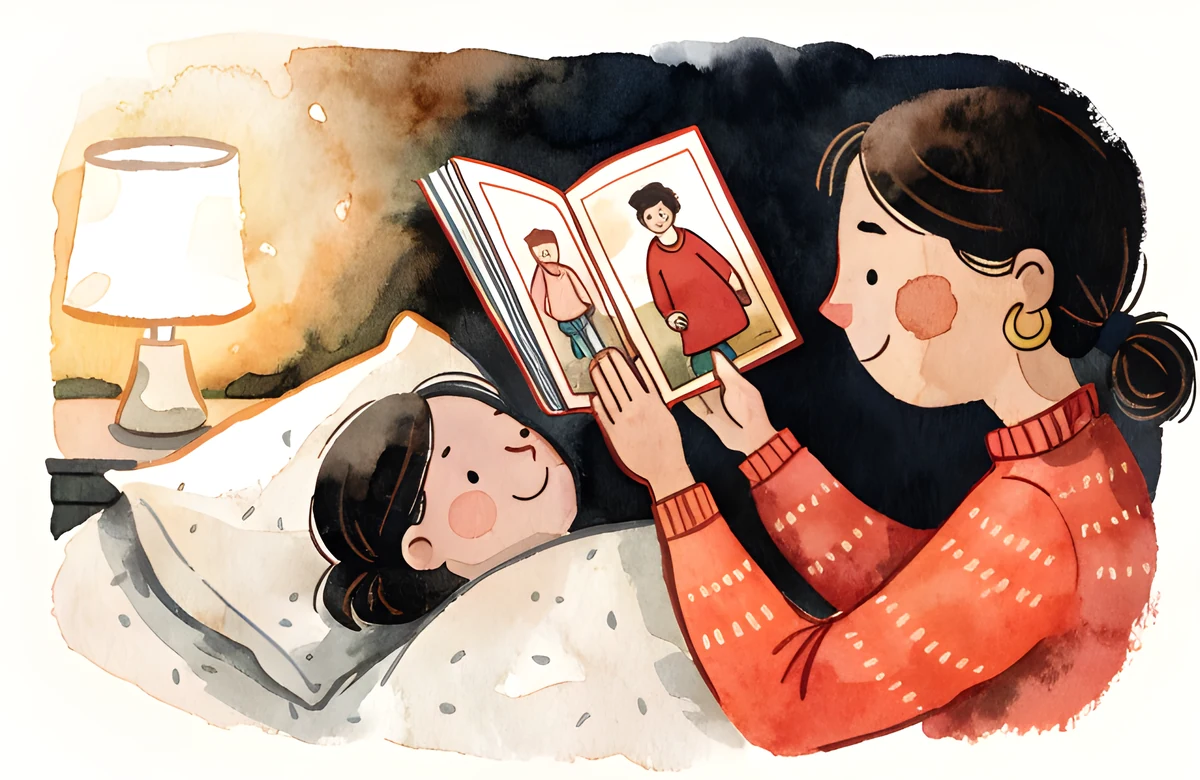
What turns reading aloud into a habit is rarely willpower. It is a fixed place in the day. For many it comes after teeth are brushed, in bed with the lamp on. For others it is at breakfast or on the bus. Choose a time that still works on a tired Tuesday in November.
Ten minutes most evenings is better than an hour on Sundays. Keep the books where you sit, not on a shelf in another room. Let someone else read now and then, a grandma or an older brother or sister, so the child hears a different voice. And if you miss an evening, it doesn’t matter. You carry on tomorrow. For many families a bedtime story is the natural place to start.
Put your phone in another room. Not to make anyone feel guilty, but because a screen lighting up on the bedside table draws the eye, and the child notices.
Let the child choose, even for the seventh time
The library is the easiest place to start. You can borrow lots of books at once and take back the ones that didn’t go down well, and the children’s librarians are glad to make suggestions.
Let the child choose, even if it’s the book about diggers for the seventh time in a row. A child who has chosen listens differently. Mix in something you enjoy yourself; your pleasure in the story can be heard in your voice. Non-fiction about animals, space or the human body is reading aloud too.
Stories in which the child recognises themselves, with their own street, their dog or their brother or sister, tend to bring out extra questions. There is even a study about it: British preschool children remembered new words better when the words appeared in a book that had the child in it. The study was small, eighteen children, so it shouldn’t be made into more than it is. But it fits with what you may notice at home.
If a book deals with something sensitive, such as moving house or a pet dying, read it yourself first. Then you know what’s coming and can pick an evening when there is time to talk.
More than one language at bedtime
If you speak several languages at home, reading aloud can happen in all of them. Read in the language you feel most at home in. A text that flows comes alive, while a text you struggle with easily turns stiff, and the child hears the language the way it sounds when someone loves it.
Some families divide it up so that one adult reads in one language and another adult in a different one. Others tell the story freely in their own language from the pictures in a book with English text. Many libraries have books in several languages.
When the child starts reading alone
Reading on your own takes effort at first, and the books a child can manage alone are often simpler than the stories they want to hear. Keep reading aloud alongside. Let the child read to you sometimes, without correcting every word, or take turns page by page.
A child who can read but still wants to be read to hasn’t gone backwards. They want what reading aloud gives: the closeness, the voice and stories a little bigger than their own reading can manage yet.
Would you like to see a finished book before you decide? Browse our example books.